How the recent FAA nationwide ground stop highlights the importance of visibility, coordination, and informed decision-making in command and control environments.
On Friday, November 13, air travel across the United States came to an unexpected halt after the Federal Aviation Administration (FAA) issued a nationwide ground stop. A technical issue affecting communications across multiple air traffic control centers led to widespread flight disruptions, leaving thousands of travelers facing delays and cancellations.
According to the FAA, instability in its telecommunications network disrupted aircraft communications and radar feeds. The agency implemented the ground stop as a precaution while technicians worked to stabilize the system. Although flights gradually resumed Friday evening, the ripple effects continued throughout the weekend. FAA
While the incident was specific to aviation infrastructure, it brings attention to a challenge shared by many industries: When critical operations are disrupted, teams need clear visibility into what's happening and the ability to coordinate a response.
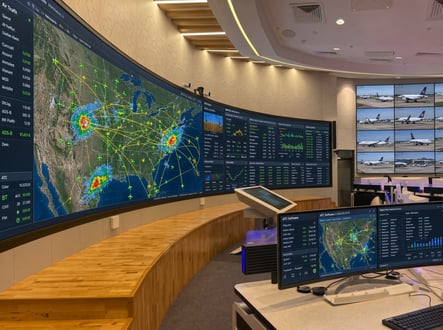
The Importance of Operational Visibility
In environments where decisions have significant consequences, teams often rely on information coming from multiple systems, locations, and sources.
When that information is difficult to access, scattered across different displays, or disconnected from the people who need it, coordinating an effective response becomes more challenging.
Command centers, emergency operations centers, security teams, utilities, and other mission-critical environments depend on their ability to:
- Monitor multiple information sources simultaneously.
- Maintain shared situational awareness across teams.
- Communicate important updates as situations evolve.
- Identify relevant information and prioritize next steps.
- Coordinate decisions between people working in different locations.
The FAA incident is a reminder that operational readiness involves more than the technology powering individual systems. It also involves how people access information, communicate, and work together when circumstances change.
How ThinkHub Supports Command and Control Teams
ThinkHub by T1V provides a visual collaboration workspace designed to help teams bring information together and work from a shared environment.
For command and control teams, that means having a centralized space to view, organize, and interact with information while coordinating with colleagues.
With ThinkHub, teams can:
Bring Information Together
Display multiple information sources on a shared digital workspace, including hardline inputs, IP cameras, and browser-based content. Teams can view relevant information together instead of switching between disconnected displays.
Maintain Shared Situational Awareness
ThinkHub's interactive Canvas gives teams a common visual environment where information can be organized, annotated, and discussed. Everyone can work from the same shared view.
Connect Teams Across Locations
ThinkHub MultiSite supports collaboration between connected locations, helping geographically distributed teams share information and coordinate their work.
Manage Complex Workflows
With flexible layouts, live content, and interactive tools, teams can organize information around their operational needs and adjust their workspace as priorities change.
Preparing for the Unexpected Starts Before an Incident
No technology can guarantee that critical infrastructure will never experience disruption. But organizations can take steps to improve how their teams communicate and coordinate when challenges arise.
That means evaluating not only the systems used to collect and distribute information, but also the tools employees rely on to make sense of that information together.
For command and control environments, having a shared visual workspace can help teams maintain context, communicate more effectively, and coordinate their next steps.
The recent FAA ground stop reinforces an important point: operational readiness depends on people, processes, and technology working together.
Give your team a clearer view of the information that matters.
ThinkHub helps command and control teams bring information, people, and workflows together in one interactive environment.
Explore ThinkHub for Command and Control or contact T1V to schedule a personalized demo.